
By Jerry Schreck, Executive Chef, Merion Golf Club, Ardmore, Pa.
The Daniel Island Club is located in picturesque Charleston, S.C. It features Tom Fazio and Rees Jones courses (Jones’ Ralston Creek course hosted this year’s Nationwide Tour Championship), with a state-of-the-art Golf Learning Center positioned between the two. The Park Club at Daniel Island houses aquatics and tennis facilities and the fitness center in a lush, resort-style setting.
Daniel Island’s clubhouse, which has gone through two major expansions and a renovation since the club was established in 2001, embodies Lowcountry elegance, with beautiful marsh, creek and golf views. In addition to a ballroom that seats over 300 and two halfway houses on the golf courses, the club offers four dining venues (70 seats for fine dining, 180 seats for casual dining, 200 seats for seasonal al fresco dining, and a 70-seat private men’s lounge). Annual F&B revenues exceed $2.5 million.
Tyler Dudley, a newly minted Certified Executive Chef, has held the top chef position at Daniel Island for the past ten years. During that time, he and his team of 25, which includes a Chef de Cuisine, Banquet Chef, Sous Chef and Executive Pastry Chef, have created an exciting mix of fine-dining and casual cuisine that ranks the club with the best downtown restaurants in a great food town like Charleston, which appears regularly on Top Ten lists of the nation’s best dining destinations. The Daniel Island Club has even earned the right to participate in the Charleston Wine and Food festival, which is normally limited to public operations.
Chef Dudley was kind enough to take time to share with us how he continually raises the bar in an exceptional club F&B operation.
CHEF PROFILE
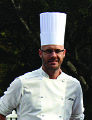 Current Position:
- Executive Chef, Daniel Island Club, Charleston, S.C. (2001–Present)
Prior Experience:
- Sous Chef, Bennett’s On Market, Charleston, S.C. (2000–2001)
- Sous Chef, Cedarwood Country Club, Charlotte, N.C. (1998–1999)
Education:
- Johnson and Wales University, Culinary Arts, 2001
- Lander University (BS, Exercise Science and Nutrition), 1994
Awards, Certifications and Organizations:
- Certified Executive Chef, American Culinary Federation
- Johnson and Wales Scholarship, 2000-2001
- Member, Sustainable Seafood Alliance
Q. Chef, for those who are not familiar with Lowcountry cuisine, can you explain all that it encompasses as far as cooking style, geography and history? Also, how have you integrated it into your menus at Daniel Island?
A. Lowcountry cuisine is the cooking traditionally associated with the coastal area of South Carolina that stretches from Pawley’s Island to the Savannah River in Georgia. This region has a rich diversity in seafood from the coast, and influences from Caribbean and African cuisine. Lowcountry cooking has a strong correlation with New Orleans and Cajun cuisine as well. We try to utilize as many local ingredients as possible in our menus, and like to put a modern spin on Lowcountry favorites, such as with our versions of Shrimp and Grits (see recipe at right) or Fried Green Tomatoes (see recipe with the online version of this article, at clubandresortbusiness.com).
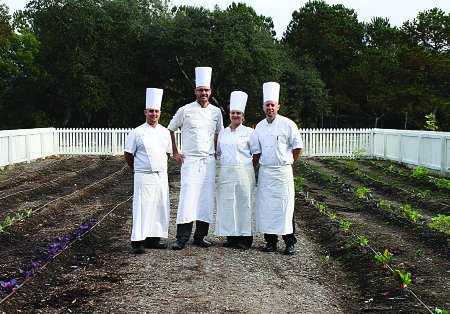
The Daniel Island Club culinary team now spends much of its time cultivating
the 100-x-40-yard garden adjacent to the 9th hole of one of the club’s golf
courses, and then back in the kitchen incorporating what it yields into a
variety of regular and special menu items. Pictured, left to right: Joseph
Strickland, Sous Chef; Tyler Dudley, Executive Chef; Caitlin Kelly, Executive
Pastry Chef; and Christopher White, Chef de Cuisine. (Not pictured: Marc
Smolinski, Banquet Chef.)
Q. A huge priority for you has been to get your culinary team out into the community, by participating in events such as the Charleston Wine and Food Festival or fundraisers like “Darkness to Light,” which raises money for the prevention of child abuse. Explain to us the positive impact this has on your relationship with your staff when these become a regular practice.
A. It’s easy sometimes to be “locked in” and focused on the day-to-day operations of a very busy private club, which can lead to forgetting what’s going on in your local culinary community. Our culinary team strives to get out there, not only to support great organizations like Darkness to Light, but also to be involved with events like the Charleston Wine and Food Festival. This not only brings great exposure to the club, it gets our culinary team excited about what we are doing here. And it gives our chefs great networking abilities with the outstanding culinary talent that we have here in Charleston.
Shrimp and Grits
Serves 6
| Amt | Ingredient |
| 1 tbsp. | grapeseed oil |
| 2 lbs. | large peeled and deveined shrimp |
| ½ lb. | Tasso ham, shredded |
| 1 ½ lbs. | andouille sausage, sliced thin on the bias |
| 2 tbsp. | shallot, chopped |
| 1 ½ cups | chicken stock salt and pepper Cheddar Grits (see recipe below) |
| 2 tbsp. | chopped parsley |
| 2 tbsp. | sliced green onion (green part only) |
| 2 tbsp. | seeded and chopped tomato |
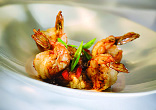 Procedure:
- Heat grapeseed oil in heavy bottom sauté pan, over medium heat.
- Add shrimp and sauté until slightly pink, then remove.
- In same pan, add shredded tasso, andouille and chopped shallot, and sauté for two minutes. Deglaze pan with chicken stock, and reduce by half.
- Add shrimp back into pan and cook an additional two minutes. Adjust seasoning.
- To Plate: Divide the hot grits between six bowls, and spoon the shrimp and sausage mixture over the grits.
- Garnish with parsley, green onion and tomato.
For the Cheddar Grits:
| Amt | Ingredient |
| 2 cups | whole milk |
| 2 cups | chicken stock |
| 1 tsp. | kosher salt |
| 1 cup | stone-ground grits |
| ¼ cup | butter |
| 1 cup | heavy cream |
| ½ cup | shredded white cheddar |
| 2 tsp. | fresh ground pepper |
Procedure:
- Bring milk and stock to a slow boil, then stir in salt. Slowly add grits, stirring constantly.
- When grits begin to thicken, reduce heat to low, and simmer for 30 to 40 minutes. Stir occasionally to avoid burning on bottom.
- Stir in butter, cream and cheese. Simmer for five minutes and then stir in pepper. Adjust seasoning as necessary.
Q. Chef, I’m surprised at the number of club chefs who now have extensive gardens on site. Having taken on a huge project with your 100-by-40-yard garden, what tips can you offer for getting beyond just having herb beds outside our kitchen doors?
A. We started about three years ago with a small herb garden, and that soon led to discussions of how to expand that resource. There has been a huge movement, not only in Charleston but also the entire country, around the farm-to-table concept—and when our President of the Daniel Island Company came to us with interest of expanding to a 100% organic garden on the property, it kind of took off from there. Some tips I can give would be to start small, do some research and not only get your culinary team involved but other departments such as course and grounds maintenance, which does the tilling and other upkeep that requires heavy equipment for us.
Q. Besides being an awesome marketing tool, has the harvest from the garden had a financial impact as you’ve grown?
A. It’s too early to tell if there will be a significant financial impact, but it has certainly affected our members and our staff members in a positive way. The members are proud of the fact that their club has taken the initiative to have a 100% organic garden. The chefs and wait staff get excited during our daily line-ups when we tell them we have Daniel Island Club garden offerings on the menus, and are then always eager to convey that information to those who are dining with us that day.
Q. Chef, you have over-the-top wedding tastings for your forty or so weddings a year. Can you describe the process and how you upsell and try to sway clients to the items that work well?
A. We have a wonderful banquet chef, Marc Smolinski, who understands how important tastings are. You have to make the client feel special, and when the chef takes time to go over each ingredient and different possible preparation for each item, it really helps with selling our product.
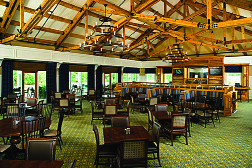 The 180-seat Grill Room (pictured at right) is one of four clubhouse dining
venues (including one for in-season al fresco seating).
The clubhouse also has a 300-seat ballroom.
Q. Finally, Tyler, how does your degree in Exercise Science and Nutrition affect your daily duties as a chef? And what should be the mindset of chefs in our industry regarding lower fat intake and healthy cuisine?
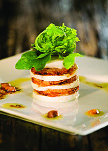 For Chef Tyler Dudley’s recipe for Fried Green Tomatoes (shown), see the online version of this article at
www.cluband resortbusiness.com
A. I believe my educational background has not only made me more aware of our members’ dietary restrictions, it has made me more sensitive to those restrictions. As a private club chef, it is imperative to be open to special requests or special dietary needs. Gluten-free and low-fat diets are now pretty common, so it is our responsibility as chefs to accommodate those needs. Our casual dining room menu changes weekly, and we have a heart-healthy section that is very popular for our members with special diets, or who have become more conscious about what they’re eating.
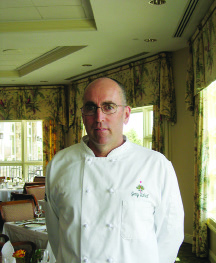 Jerry Schreck is a member of the Club & Resort Business Advisory Board. Know someone you’d like to have Jerry interview for a future “Chef to Chef” conversation? Send your suggestions to [email protected]
Fried Green Tomatoes
Serves 12
| Amt | Ingredient |
| 1 cup | buttermilk |
| ½ tbsp. | Tabasco sauce |
| 1 cup | yellow cornmeal |
| 1 cup | all-purpose flour |
| ½ tsp. | baking soda |
| 1 tsp. | kosher salt |
| 1 tsp. | fresh ground pepper |
| 5 lbs. | green tomatoes, sliced thick |
| 1 lb. | sliced fresh mozzarella |
Procedure:
- Mix buttermilk and Tabasco together, and set aside.
- Add sliced tomatoes to milk; mix and marinate for one hour.
- Combine next five ingredients in a separate container.
- Drain tomatoes and lightly dredge in mix. Fry.
For the Black-Eyed Pea Viniagrette:
| Amt | Ingredient |
| 2 cups | cooked black-eyed peas |
| 1 | red bell pepper, brunoise |
| 1 | yellow bell pepper, brunoise |
| 1 | green bell pepper |
| 1 | red onion, brunoise |
| 2 tbsp. | chopped basil |
| ½ tbsp. | oregano |
| 1 tbsp. | chopped thyme |
| 1 tbsp. | chopped chives |
| ¼ cup | red wine vinegar |
| ¼ cup | sherry vinegar |
| ½ cup | extra-virgin olive oil |
| to taste | kosher salt and fresh ground pepper |
Procedure:
- Combine first eight ingredients (peas through thyme) together, and set aside.
- Whisk next four ingredients (chives through olive oil) together (mixture will not emulsify).
- Combine all ingredients together.
To plate:
- Alternate fried green tomato slices with fresh mozzarella; finish with black-eyed pea vinaigrette.


Tell Us What You Think!
You must be logged in to post a comment.